Abstract
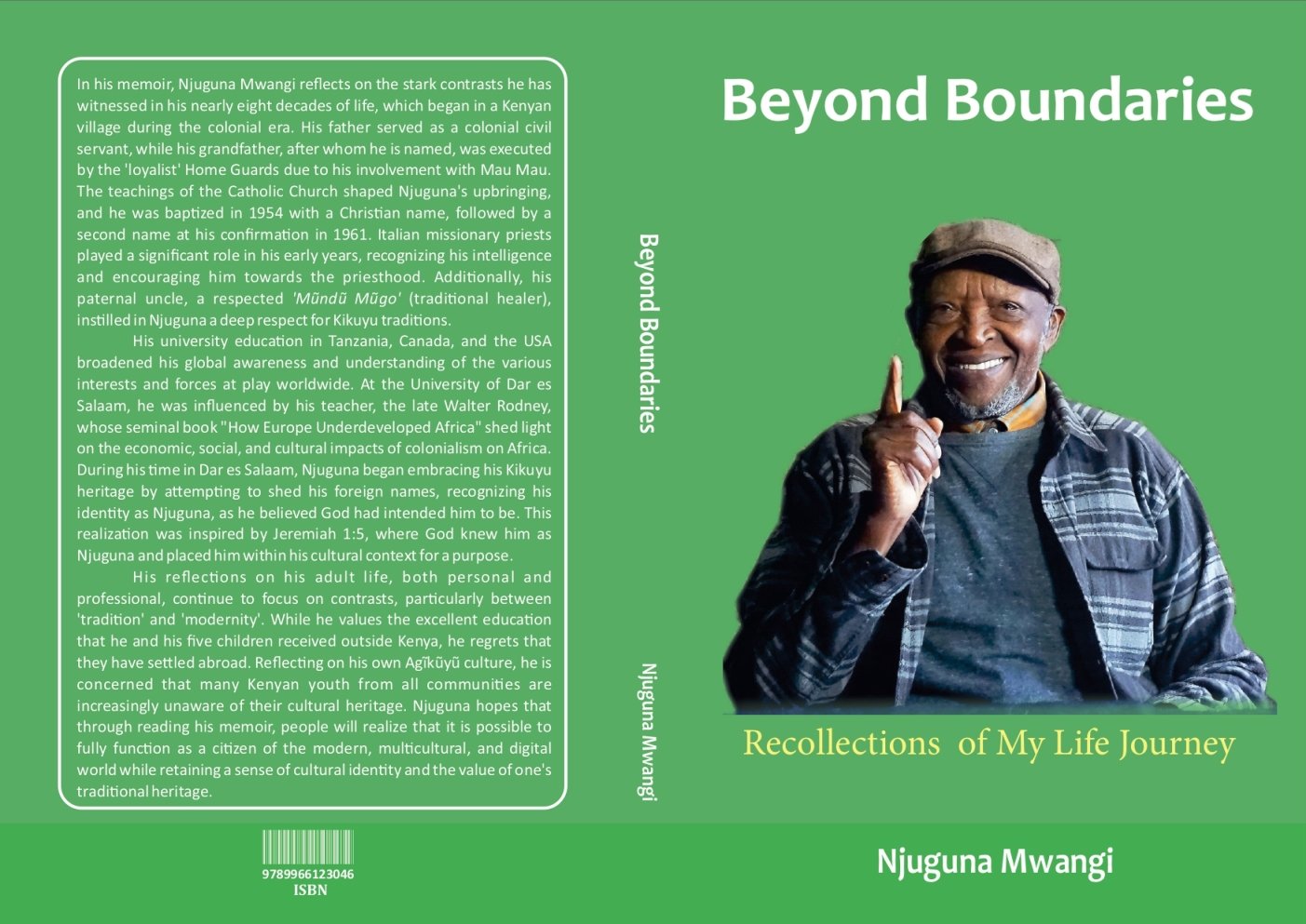
In Beyond Boundaries, Njuguna Mwangi crafts a sweeping memoir that transcends autobiography to become a chronicle of empire, education, and awakening. Spanning nearly eight decades—from a boyhood shadowed by British colonialism in Kenya to a life of global mobility and moral reflection—the book interrogates what it means to be human amid structures of domination.
Through interpretive depth and quiet courage, Mwangi revisits the landscapes of his youth, the lessons of missionary education, and the burden of faith shaped by colonizing Christianity and its Slave Bibletheology of submission. Beyond Boundaries resonates as a parallel history of resilience, echoing civil-rights struggles, immigrant journeys, and the universal yearning for freedom. This review explores the memoir as both testimony and critique—a meditation on the fractures of empire and the stubborn endurance of the human spirit.
I. Early Life in Colonial Kenya – Childhood Beneath the Shadow of Empire
Mwangi’s early years unfold against the tension-filled canvas of colonial Kenya, where the British Empire sought to refashion both land and soul. His childhood village life, described with intimacy and historical precision, becomes a microcosm of Africa under siege—its rhythms disrupted, its people redefined, its moral center contested. The child grows up hearing gunshots and whispers of rebellion. Executions are not abstract but lived trauma.
The Mau Mau uprising, long vilified as savagery, emerges as a desperate cry for justice. Mwangi recounts two Itungati who chose death over betrayal—a haunting testament to integrity amid torture. Their suicides become symbols of moral victory, proof that dignity can survive even when bodies cannot. His narrative transforms the colonial child into both witness and chronicler, restoring African agency erased by imperial archives. Yet amid cruelty, Mwangi discovers moral endurance: his mother’s faith, his father’s calm, and the communal ethic of harambee. Even under empire’s shadow, the African child learned not only submission but observation—a foundation for later critique and empathy.
II. The Education of a Colonized Mind – Learning in the Master’s Language
Colonial schooling reveals education as both bondage and awakening. The Beecher Report of 1949 defined African learning through obedience and catechism—discipline before discernment. In classrooms where punishment mingled with prayer, English became both ladder and leash. To excel was to mimic the colonizer, yet within those idioms lay the seeds of critique.
Like Ngũgĩ wa Thiong’o and Chinua Achebe, Mwangi embodies the double consciousness of the colonized learner: educated to conform yet destined to question. Religion reinforced control, replacing ancestral spirits with imported guilt, but later reflection transformed indoctrination into awakening. Distinguishing Christ’s compassion from the Church’s colonization, he reclaimed faith as discernment. Education thus became emancipation, turning empire’s tools into instruments of self-definition.
III. Work and the Search for Identity – Between the Village and the World
Education led Mwangi into work, where colonial legacies lingered beneath independence. To labor was to prove worth within systems still shaped by empire. From local administration to international consultancy, he confronted the persistence of classism and mimicry. Yet he remained analytical, not cynical. Work became both burden and blessing—a means of asserting dignity through competence. His professionalism embodied ubuntu—“I am because we are.” Across continents, he found inequality in new guises but insisted that true liberation is psychological as well as political.
IV. Faith and the Slave Bible Doctrine – The Colonizing Church and the Conscience of the Believer
Mwangi exposes the paradox of a gospel that preached love yet justified enslavement. The Slave Bible—stripped of liberation texts—became the empire’s moral weapon. Missionaries prepared Africans to surrender both land and self. Yet Mwangi does not reject faith; he redeems it. Distinguishing Christ’s message from imperial distortion, he calls for a return to compassion and justice. Echoing Frederick Douglass, James Cone, and Howard Thurman, Mwangi insists that faith must serve freedom, not fear. Spirituality thus becomes resistance—a reclamation of the divine from domination.
V. Faith, Memory, and Moral Geography
Mwangi widens his lens to show how religion, memory, and geography intertwine. The Abrahamic traditions—Judaism, Christianity, and Islam—began as movements of liberation but were co-opted by empire. His diasporic journey transforms geography into theology: villages where faith was pure, cities where belief was tested, continents where conscience matured. Migration becomes meditation; memory becomes moral compass. Writing itself becomes healing—memory as resistance, testimony as therapy.
Conclusion – Beyond Boundaries as Witness and Warning
Beyond Boundaries stands as both witness and warning—a memoir that redeems history through compassion. Mwangi’s journey from colonized child to global elder illuminates conscience enduring over cruelty. His story urges societies to confront the spiritual residues of empire that still distort justice. It offers both indictment and invitation: to remember rightly, live ethically, and believe humanely.